
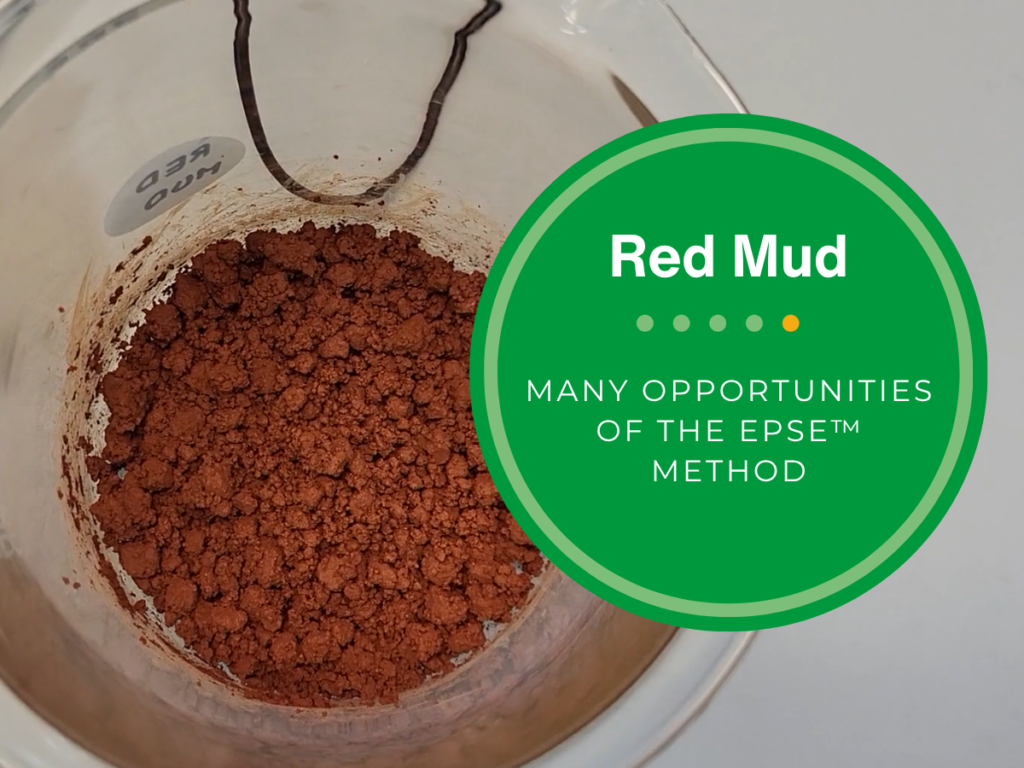
The most obvious application for the EPSE™ Method is in mines: wastewater from the mining industry is typically acidic and contains varying amounts of dissolved heavy metals. However, in addition to mining effluents, our technology has many other applications, some of which may even be surprising. In our new article series, we highlight these various applications where EPSE technology can solve even the most challenging problems. This article focuses on red mud.
Red mud: one of the world’s most common industrial wastes
Red mud is a waste product generated during aluminum production that, as its name suggests, is red in color due to the iron it contains. Red mud is alkaline and very fine-grained, which makes its treatment, dewatering, and storage challenging. Typically, the waste is stored by dumping it in open landfills, which causes dust and poses environmental risks to soil and water. According to the International Aluminum Institute (IAI), 1.2 metric tons of red mud are generated for every metric ton of aluminum produced, and up to 10 billion metric tons will be stored globally by 2050. This is a major challenge, but also a promising opportunity.
However, red mud is not merely waste: the metals and minerals it contains can be recovered, and the processed material can potentially be utilized, for example, in water treatment and other circular economy applications. The utilization of red mud has been extensively studied, and metals such as iron, aluminum, titanium, and rare earth elements can be recovered from it (Agrawal 2021). Red mud has also been studied as a material capable of binding contaminants in water and wastewater treatment (Bhatnagar 2011).
EPSE Treatment of Red Mud
In EPSE treatment, red mud is first mixed with water to form a pumpable slurry, after which its pH is lowered to dissolve the metals. This is followed by the separation of solids from liquids and the recovery of soluble metals using the EPSE™ Method. In EPSE treatment, metals are separated, and the goal is to produce clean, recyclable water as well as a metal fraction from which metals and other valuable materials can be recovered using various physical methods. Red mud has been extensively studied in the EPSE laboratory, and the treatments have proven highly successful on a laboratory scale. The next step is to scale up the testing to verify the economic feasibility.
Below, you can see in practice how a Red Mud Sample was tested for the EPSE™ Method in our Lab Hub. Note that all samples are tested individually, and the treatment process may therefore vary depending on the specific characteristics of the sample and the customer’s objectives.
Incorporating Industrial By-Products into the Process
At its best, EPSE’s treatment process can be designed to utilize industrial waste and by-product streams instead of virgin raw materials. For example, spent sulfuric acid can be used to adjust the acidity of red mud and to leach metals, while waste alkali can be utilized in the later stages of the treatment process. The excess water generated during EPSE processing can be recycled back into the process, and the multi-metal concentrate can be analyzed to determine the potential for recovering critical raw materials and rare earth metals.
Interested in finding out more?
This article was written by Anna Kivimäki and Anni Honkonen.
References:
[1] International Aluminum Institute. Refining: Bauxite Residue Management. Available at: https://alustory.international-aluminium.org/mining-refining/bauxite-residue-management/
[2] S. Agrawal and N. Dhawan. 2021. Evaluation of red mud as a polymetallic source – A review, Minerals Engineering 171. 107084.
[3] A. Bhatnagar et al. 2011. A review of the use of red mud as adsorbent for the removal of toxic pollutants from water and wastewater. Environmental Technology, vol. 32, no. 3, pp. 231–249.