
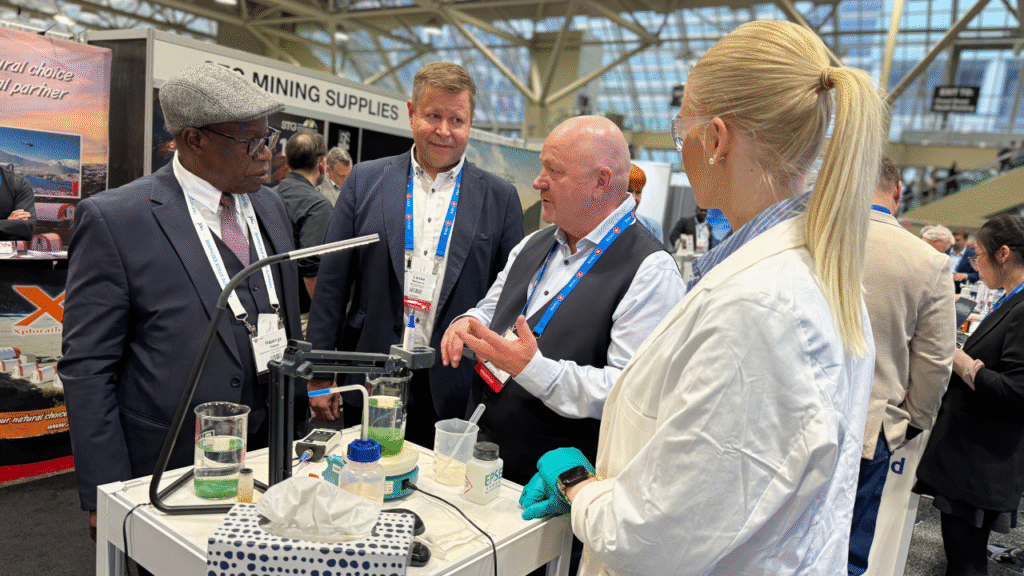
When EPSE’s team is asked what stands out most from 2025, the answers consistently point to the Green Zone concept, a new strategic expansion enabling the recycling of industrial side streams, the culmination of long-term efforts in Central Asia through memoranda of understanding signed in November–December with consequent launch of the first Green Zone projects, and the developments within the Laboratory and Technical teams. Viewed from different angles, the year has clearly been one of strong growth. As our CEO has put it, EPSE has moved from a local train to a bullet train, a shift that reflects as high expectations for the coming year as well.
Different locations, but in the same direction
EPSE’s international growth has been made possible by our partners, collaborators, and state-level actors. The Team Finland network, Business Tampere, EastCham Oy, and Mining Finland have provided unique opportunities to establish contacts with local industry stakeholders. Through the Finnpartnership program, we have continued our work to access new market areas, identified local partners, and carried out industrial piloting in remote locations. The strengthening of our local presence in South and North America, southern Africa, and Central Asia has materialized in the form of new customers, successfully completed local studies, and pilot projects.
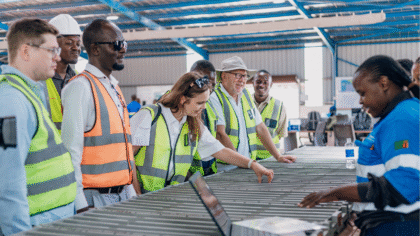
Prosep Chemicals, EPSE’s partner in South Africa, has secured highly promising customers in the mining and metals industries and launched several pilot projects in the region, making extensive use of local expertise. Another key partner, East Technic LLC in Uzbekistan, has over several years enabled local studies and arrangements that have ultimately led to Green Zone agreements.
Our position in industrial-scale implementations has been further strengthened not only through new recruitments to the technical team, but also through signing a cooperation agreement Finnish engineering design partner Cemec Consulting Engineers Oy who’s CEO, Mika Kärkkäinen, is a long-standing acquaintance of EPSE. In addition, the decades of experience in mining and water treatment brought by CEO Blane Wilson, and COO Steve Evans of EPSE Technology Inc, headquartered in Nevada, have added new dimensions to EPSE’s offering and played a key role in creating the prerequisites for implementing Green Zone recycling centers. Overall, we have been able to build more comprehensive water treatment and process expertise around our own technology, further strengthening EPSE’s credibility and role as an operator.
Looking at our own staff, EPSE’s 15-person team consists of individuals from diverse backgrounds and locations. During the year, their needs have been addressed by enabling flexible remote and hybrid working arrangements and by investing in the continuous improvement of well-being at work. The way of working is guided by the idea that physical location is not decisive in knowledge work, particularly when addressing global challenges. According to Anni Honkonen, who is responsible for well-being and occupational safety at EPSE, leadership, maintaining connections between colleagues, and investing in information flow are more important than location in knowledge-intensive work.
The benefits of a flexible organization should not be underestimated, as demonstrated personally by the author of this article, who was able to relocate to the French Alps at the beginning of the year while continuing to work as a project engineer. At the same time, our newest team member Severi Lintula works efficiently from Espoo, our China expert Yi Fang continues his work in Shanghai, and Khawer Shafqat, originally from Pakistan, has been given the flexibility to work both in Finland and in his home country.
Not only are wastewater challenges global, but fully location-bound work is increasingly a remnant of a time when circumstances physically tied work to a specific place. In modern knowledge work, leadership, collaboration, and information flow matter more than geography.
Increased student cooperation and responsibility
In terms of student cooperation, EPSE had a record year in the number of completed theses, as Laboratory Engineer Anette Anttonen and EHSQ Manager Anni Honkonen both completed their degree studies alongside their work. Anttonen graduated with a Bachelor’s degree as a Laboratory Engineer, while Honkonen completed her Master’s degree in Industrial Engineering. In addition, Niko Lodman from Jyväskylä University of Applied Sciences completed his thesis on the carbon footprint of the EPSE™ Method under Honkonen’s supervision. One further thesis project will begin at the end of the year, focusing on the feasibility of the Green Zone concept.
Beyond her role in student supervision, Honkonen’s academic background and hands-on experience shape EPSE’s approach to responsibility and HSEQ development, and although the company’s HSE practices are at a good level for a small organization, development will continue in a systematic manner next year. According to Honkonen, the key priorities for HSEQ and responsibility work will be closely linked to the Green Zone concept, particularly its associated studies, processes, and operating principles. EPSE will also begin voluntary responsibility reporting in line with the EU’s VSME framework, in preparation for forthcoming CSRD and ESG requirements that will become mandatory as operations expand. Voluntary reporting is seen as a way to build capabilities in advance and ensure that responsibility supports the future scaling of business operations.
As a small company, our HSE practices are in excellent shape, but there is always room for improvement. Next year, we will continue to take further steps – perhaps even leaps – in our development.
– Anni Honkonen
EPSE Lab Hub: growth and new capabilities
Looking at the year from the perspective of the EPSE laboratory, 2025 has brought development on several fronts. During the year, multiple development, research, and cooperation projects were launched with both Finnish partners and international operators. Examples include collaborations with Zhejiang in China and JSC Almalyk MMC (AMMC) in Uzbekistan, which culminated in delegation visits to our Lab Hub. The laboratory has also played an important role in EPSE’s international activities, particularly by supporting successful customer pilot projects in Uzbekistan and Spain.
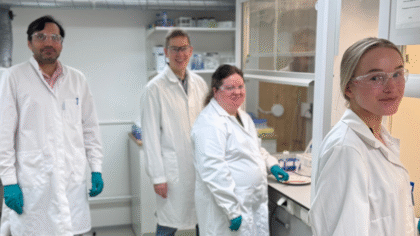
Growth in operations has required a strengthening of laboratory expertise. At the beginning of the year, Mikko Rautiainen, PhD in Chemistry, joined EPSE as Laboratory Manager. He was joined by Tanja Pikkarainen, a laboratory technician with nearly 20 years of experience in industrial laboratories, as well as Khawer Shafqat, who returned to research work after previously serving as a Solution Manager in Pakistan. The successful integration of these experts has created a strong foundation for further developing laboratory operations.
The laboratory’s analytical capabilities have been expanded to support new applications, including extending ICP-OES analysis to rare earth elements and developing acid extraction methods for solid samples. Method development is a key element of improving laboratory self-sufficiency. According to Rautiainen, the ability to analyze metal concentrations in solid samples is essential for evaluating future Green Zone plants and related material streams. Expanding the analytical offering to rare earth elements and other critical metals enables the benefits of the EPSE™ Method to be demonstrated reliably, particularly from a metal recovery perspective.
During the year, the laboratory team has further strengthened its expertise through training related to quality assurance, including pH electrode calibration and high-precision weighing. This training supports the accuracy, repeatability, and traceability of measurements, which are critical for reliable analysis and reporting. Plans for next year include continuing flexible internal training and participating in proficiency testing organized by SYKE, providing independent feedback on laboratory quality management.
From local train to bullet train
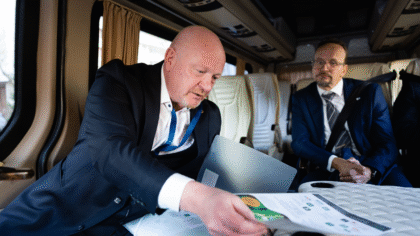
The year 2025 will remain in the memory of our CEO, Jouni Jääskeläinen, as a clear turning point. During an industrial wastewater pilot project conducted in late May and early June, the significant CRM and REE potential of Uzbekistan’s JSC AMMC was identified. This discovery rapidly transformed what had initially started simply as a water treatment project. In Jääskeläinen’s words, the local train quickly turned into a bullet train. These findings laid the foundation for the Green Zone concept and the subsequent agreements and cooperation initiatives. The concept brings together technology, process expertise, and responsibility in a way that directly addresses the growing needs of industry.
The strategic offering in industrial wastewater treatment and the recovery of critical raw materials and valuable metals has been enthusiastically received by the market, rapidly strengthening EPSE’s position as a provider of comprehensive solutions. Accelerated growth also brings new challenges for the coming year. As projects are increasingly located far from EPSE headquarters, Jääskeläinen highlights as key challenges the coordination of domestic and local resources and managing overall capacity. These will be addressed by strengthening the organization, establishing new local partnerships, and developing operating models to support a growing project portfolio.
Finally, Jääskeläinen wishes to express his gratitude to EPSE’s partners and readers and wants to highlight that the agreements formed around the new concept, together with increasing demand, create opportunities for partners to grow alongside EPSE. This trust and collaboration provide strong momentum for the company’s next steps.
This article was written by

Anna Kivimäki
Project Engineer
anna.kivimaki(a)epse.fi
Follow us in social media!


List of figures:
- Honkonen, A. (2025) EPSE’s Jouni Jääskeläinen and Anni Honkonen in discussion with Dr Hapenga Kabeta (Permanent Secretary, Ministry of Mines and Minerals Development of Zambia) and Lasse Moilanen (Mining Finland / BioSO4) at PDAC 2025 in Toronto. (Accessed 17 Dec 2025)
- TMILADZI (2025) Embassy of Finland visit. (Accessed 17 Dec 2025)
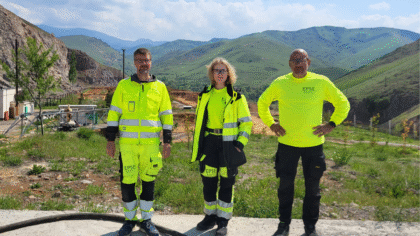
- Kivimäki, A. (2025) EPSE’s pilot team in Uzbekistan. (Accessed 2025)
- Honkonen, A. (2025) EPSE’s laboratory team. (Accessed 17 Dec 2025)
- Niiranen, J. / HS (2025) President Alexander Stubb visits Astana, Kazakhstan, on 28 October 2025. He is received at the Presidential Palace by President Kassym-Jomart Tokayev of Kazakhstan. (Accessed 17 Dec 2025)