
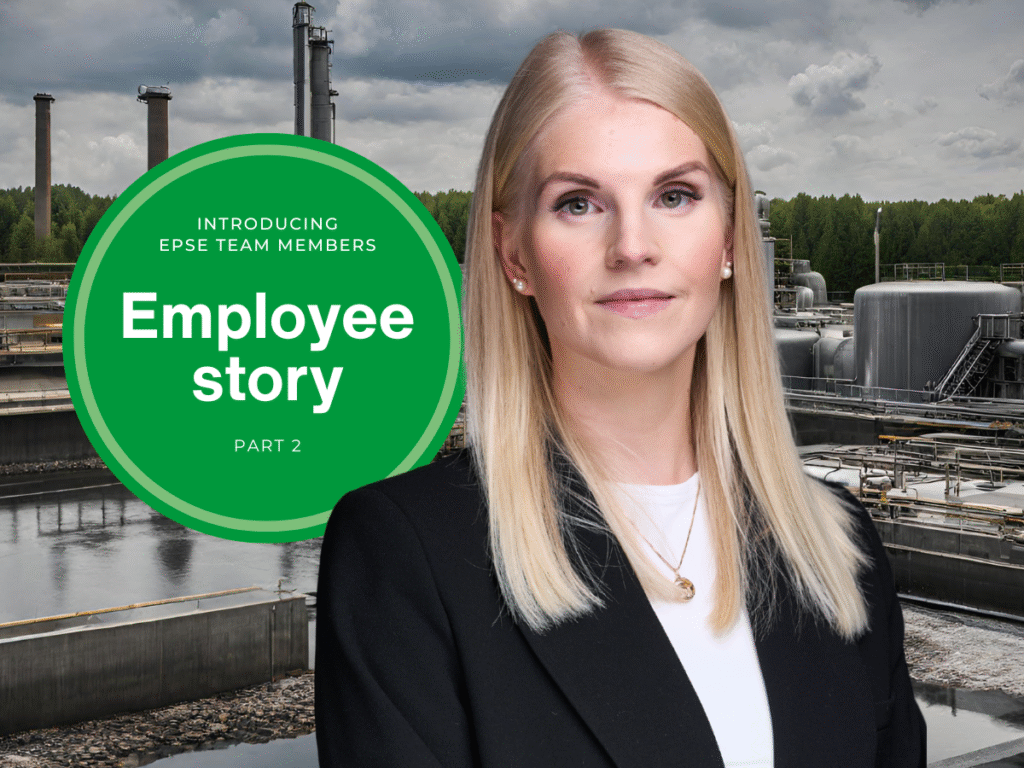
At the beginning of January, I completed my seventh year at EPSE, and I can somewhat reflect on my journey from a student in my twenties to a professional in my thirties. My path has not been straightforward, but on the other hand, it has been stable – I have been with the same employer since the early stages of my career, so I can’t help but wonder: have I missed out on something, or perhaps experienced something enviable in this day and age?
Education from three universities
I first studied biology at the University of Turku, but I quickly realized that the Latin names of organisms did not correspond to my idea of an interesting subject. I moved a few kilometers further along the Aura River to the now-closed Sepänkatu campus of Turku University of Applied Sciences to study engineering. True to my style, I completed my studies a year ahead of schedule, gaining all the essential experience from student life, with its parties and tutoring responsibilities, as well as from working in a research group at the university of applied sciences alongside encouraging colleagues.
Following this path led me to a role as a project coordinator at EPSE, in the midst of the dynamic – and at times somewhat chaotic and unfinished – everyday life of a small company. I completed my bachelor’s thesis and graduated during my first year of work, and at that time, I had nothing else in mind but to work for the foreseeable future – during my studies, I gained experience from three different employers at the same time, so my palette was pretty full for a long time.
After surviving COVID-era, I decided to complete my education at the University of Tampere’s Hervanta campus (formerly known as TTY). In the spring of 2025, I graduated with a master’s degree in technology, with safety engineering as my major and industrial engineering as my minor, while continuing to work. My teekkari cap is on display at home, reminding me that I survived engineering mathematics ten years after high school exams, so no task that comes my way is too difficult.

Work experience in many roles – the best aspects of a small company
Every company is unique, and all of them undoubtedly have their good and bad sides. The best thing about working in a small company is definitely the diversity and the fact that you get to deal with a wide variety of tasks, situations, challenges, and solutions. One person handles several areas, decision-making is agile, there is little bureaucracy, and hierarchy is often non-existent. The pace is fast.
My first role was project coordinator, but over the years it has evolved to also include HSE responsibilities, information management, and marketing. I took a course in occupational safety and health management about five years ago, and I handle statutory occupational safety and health tasks together with the occupational safety and health representative and the CEO. I am responsible for information management, for example, as the admin user of the document and communication management systems, and together with my team, I ensure that documentation, reporting, and communication processes are in place and continuously developed. We also develop other processes, such as piloting and customer processes, together with other teams and partners.
Together with my team, I also create all content for EPSE’s website, social media channels such as LinkedIn and YouTube, and many marketing materials such as brochures and presentations that other EPSE employees need.
I have traveled with EPSE on piloting trips lasting over a month and to international trade fairs around the world, and met people I would never have met as part of a larger corporation, such as CEOs, board chairpersons, ambassadors, and ministers.

My own team, the best team
In a small company, work is done in close cooperation with others, and your own expertise is supplemented by that of your colleagues wherever and whenever needed. At EPSE, the whole company is practically one team, as we work together in a concrete way: the entire staff attends many weekly meetings, and at the Ylöjärvi office in particular, we work together with the people who are needed at any given time. However, teamwork is not an end in itself. If the work requires independent work, remote work is flexibly possible.
My colleague Anna Kivimäki started at EPSE a few years ago as an intern and, under my guidance, wrote a commendable thesis on EPSE’s pilot equipment. After graduating, Anna became a project engineer, and my one-woman power team expanded into a two-woman power team. It is a pleasure to work with Anna, as she is innovative, proactive, and efficient, as well as skilled in areas where I myself am not.
There are also challenges
Working in a small company also has its less glamorous sides. Multidisciplinarity and diversity of job descriptions are not for everyone. Some people want clearly defined and fixed frameworks for their work, and in that case, it makes sense to seek out an organization that provides that. In addition, resources are measured on a different scale in small companies than in large ones. Often, the reality of a small company is that resources are tight, and you need to have strong faith in your own doing and success in order to be able to make compromises. Applying for funding is an everyday occurrence, and the bureaucracy involved in those applications can sometimes be tedious.
The importance of the team is also emphasized, and in a small community, personal chemistry is hugely important, as there is no one to avoid. Creating, maintaining, and developing processes supports the work and reduces the importance of personal relationships, but in a small team, you still have to get along with literally everyone. This also requires (self-)management skills and social intelligence not only from managers but also from team members.
Towards equality in working life
Finnish (and international) industry still has gendered structures that need to be shaken up. There are still too few women in leadership positions, and sometimes the lack of women at the grassroots level also manifests itself in practical problems: in one pilot site in the 2020s, there were no social facilities for women at all, as there had never been a need for them. Even in Finland, there is still an inexplicable 5.5% pay gap between women and men in the technology sector (the total pay gap is around 10%1), so change is needed.
At EPSE, opportunities have always been given regardless of gender or nationality. I believe that we have the opportunity to overturn prejudices and outdated ways of thinking. This is most clearly seen in field pilots, where I sometimes work in roles that are often seen as masculine.

We are also happy to collaborate with students on various projects, and I supervise theses, for example, when we have the resources to take on thesis writers and the subject matter is close to my own expertise or experience. So far, I have supervised four theses, and when I read the latest feedback, I was almost moved by the tone of praise.
I also attend events and occasions at educational institutions to talk about my study path when the opportunity arises. I think that if I can give an honest view of the opportunities available in working life, and if even one girl is inspired by it and decides to apply to study technology or natural sciences, then I have done something right. I don’t want to emphasize the “ethos of doing your own thing,” but it’s worth following your own interests, even if work in general has other meanings (than being the center of your life).
What’s next?
I still have a lot to learn, especially about the next phase which we are moving into with the US company EPSE Technology Inc, after signing the Green Zone agreements in 2025.
Over the years, my job at EPSE has been shaped primarily by the company’s needs, but also by my skills and interests. I feel that I have learned about water treatment and the mining industry, yes, but also about leadership and social skills for working life.
I have the privilege of learning not only from my colleagues, but also from my superiors and our partners, such as EPSE’s CEO Jouni Jääskeläinen as well as Steve Evans and Blane Wilson from EPSE Technology Inc. All three are seasoned professionals in their fields, with the experience and knowledge that comes with age and years of experience, but also a lively sense of humor, which ensures that work is always done with a positive attitude. In my opinion, that carries you through everyday life better than anything else.
Reference: (1) TEK (2023). Salaries of men and women in tech. Available at: https://www.tek.fi/en/services-and-benefits/research/tek-studies-diversity-equality-and-inclusion/salaries-of-men-and-women-in-tech.
This article was written by

Anni Honkonen
EHSQ Manager
anni.honkonen(a)epse.fi
Follow EPSE in social media!


